12/18/2017

Tax Bill Closes Door on Needed Solutions

In his book On the Brink detailing the inside story of the 2008 financial meltdown, former Treasury Secretary Hank Paulson relates how, as the financial system was crumbling and in desperate need of immediate cash, GOP lawmakers argued for stimulatory tax cuts. In today's booming economy with little room for upside growth, GOP lawmakers argue for stimulatory tax cuts. As the old cliche goes, when your only tool is a hammer, every problem looks like a nail. There could not be two economic scenarios more disparate than those described above, and yet, all the GOP can suggest is a shopworn, one-size-fits-all solution. Nothing could better demonstrate the vacuum that passes for intellectual conservative thought these days.

It is more than a shame, because given the disruptive nature of today's economy - from job-killing technologies to the rise of new global economic powers - the need for new ideas to address the challenges we face has never been greater. Unfortunately, such thought is in limited supply. Instead, stale thought is about to lock us into another decade (generation?) of record deficits at precisely the time we need fresh, disruptive thought to match the economic disruption of the times.

The challenges we face are myriad. We have entire communities whose livelihoods have disappeared, as trade and technology have reduced the value of the repetitive skills and reliable work habits of those folks, while simultaneously improving the profitability of those they once toiled for. That is both the elegance and the evil of capitalism's creative destruction, displacing the few for the greater good. However, unlike days gone by, when the displaced could rather quickly and easily find often better-paying work requiring similar skill sets (think manual laborer moving from farm to factory), today's disruption often leaves those displaced with options that offer neither the pay nor protection of their previous employment. Thus, the family breadwinner who had health insurance and a pension to go with his or her $25 or $30 an hour factory job frequently feels fortunate to find a job without benefits at half the pay.

And yet, our public response is not to address the pain and pathologies these forgotten people and communities suffer, but rather, to reward those benefiting from that misfortune by cutting taxes even further on the additional profits that accrue from the misery that offshoring and automation inflicts upon those left behind. Hoping those tax savings will be invested in ways that help those suffering ignores that it is the investment of past tax cuts that gave us the technology and lobbying power that helped eliminate these jobs in the first place. The argument that we've weathered such dynamics before as new businesses absorb those made obsolete ignores the fact that today's technology delivers a double-whammy in that technology is not seeking to make repetitive manual labor easier, but to eliminate such work altogether, thus requiring a new skill set that cannot be learned quickly - all while the pace of such change accelerates more each day, making it nearly impossible for the displaced to keep up.

This disruption will only get worse. As robotics and artificial intelligence make more roles obsolete, we'll see even those thought secure at risk of marginalization. The same technology that transformed the shop floor can now be seen in warehouse automation, order entry and checkout kiosks and more. Self-driving trucks threaten to eliminate some two million high-paying blue-collar jobs. And everyone from diagnostic radiologists to software coders are in the crosshairs of the automation revolution. As society becomes more and more automated, as more and more workers are marginalized, the benefits will accrue to those who remain, whose numbers will be ever fewer.

That seems only fair, but at what cost? We already see entire communities struggling under a wave of addiction. Families fret over how to pay for needed health care, let alone the education they know their children will need to survive in this changing world. The anger that has divided us and delivered today's dysfunctional leaders will only get more vocal, more desperate. We risk permanently cleaving into two separate societies - one plagued by crime, poverty, addiction and poor health, the other safely protected in gated communities. That is not freedom. Not for those unable to provide for their families and not for those living behind guarded gates.

The irony in all this - and the great opportunity we are about to squander when this tax bill becomes law - is that what business craves most, what they consistently argue is the greatest need they have, are skilled, reliable, educated workers. Yet an intellectually bankrupt GOP is about to deliver more of what they don't need, and in the process severely cripple our ability to invest in what they do need. They'll argue this tax cut will spur growth that will cure our ills. But when it proves once more it won't, they'll then argue we haven't the resources to invest in people or education or infrastructure or addiction treatment. And so, they'll argue for another round of stimulatory tax cuts, while our roads deteriorate, our schools suffer and an ever larger portion of our population falls further behind. Lather, rinse, repeat.

There's another familiar cliche, one that says doing the same thing over and over while expecting a different result is the definition of insanity. Well, that describes the GOP's tax bill. We've been pursuing that path for a generation now, leaving a trail of forgotten Americans who are slowly losing the wherewithal to educate their children for a future that seems ever further out of reach. Is that really our best path forward? Are we not the nation of immigrants whose parents sacrificed their own creature comforts for the well-being of future generations? Did we not learn their lessons? If not, what have we become - and is this who we strive to be?

12/15/2017

Nationalists Were Wrong in 1992, They are Wrong Today

In the days before the internet I would actually write down thoughts, not to be shared with the world, but to capture them for later consideration. Here is one of those journal entries from March 1992 that seems to have some meaning today:

"There are conservatives (such as Pat Buchanan) who have the attitude that it's 'us against them,' whether 'us' is the U.S., working people, WASPs, etc. They simply want to hold onto what 'we' have and screw the rest. On the other hand, there are conservatives who feel that all can benefit through conservative principles. This approach is promoted by people such as Jack Kemp through 'Empowerment.' I definitely subscribe to the latter."
I would argue that today's Republican Party has been taken over by the Pat Buchanan wing, as personified by Steve Bannon and Donald Trump. Thus, why I find myself so opposed to it and the president. I have never been a believer in the us vs. them, zero-sum narrative upon which they base their entire approach to governing.


========================================
Updates

September 8, 2022

This NY Times op-ed on September 8, 2022 makes the case that Pat Buchanan Didn’t Plan on It, but He Paved the Way for Trump

November 20, 2023

Yesterday, conservative evangelist David French wrote a column in the NY Times warning of the hateful anti-semitism unleashed by the right in the wake of Israel's response to the Hamas terror attacks last month. In it, he references Pat Buchanan's role in this shift in right wing ideology:
"Buchanan is no minor figure. As Nicole Hemmer wrote in 2022, his presidential campaigns in the 1990s forecast the present moment in Republican politics. The party “traded Reaganism for Buchananism,” she contended. The evidence that she was correct grows by the day.

"Everything about the New Right mind-set told us that this devolution was inevitable. It scorns character, decency and civility in the public square, often turning cruelty into a virtue. This was a necessary precondition for the entire enterprise. Decent people can be misguided, certainly, but they are not consumed with hate. Decent people do not indulge bigots.

"The New Right rejects the norms and values of what it calls the uniparty or the cathedral: the center-left and center-right American elite. And one of those values is a steadfast opposition to racism and prejudice. The rejection first manifests itself in the form of just asking questions, then it veers into direct challenge of conventional norms, followed by a descent into true darkness.

"Hostility unmoored from character quickly turns conspiratorial, and the world of conspiracy theories is where antisemites live and thrive."

We are on a dangerous path, where hate and intolerance not only become acceptable, they are presented as measures of virtue and patriotism. We've seen this story before and it rarely ends well. This is precisely why I wrote this in 2016, calling that year's presidential race a "right side of history election."


11/19/2017

Tax Reform is a Dangerous, Irresponsible Gamble

Donald Trump ran on the promise to make America great again. Though hardly central to that promise, tax reform has been presented as part of the path back to such greatness, however that greatness may be defined. Unfortunately, perhaps due to the President's populist urges, perhaps due to pressure brought to bear on GOP legislators by wealthy donors, perhaps due to mere desperation to pass something, tax reform has morphed into little more than supply side-style tax cuts that once again make the dubious promise to pay for themselves through the enhanced economic growth they are expected to unleash. That is not a path to greatness. In fact, it is almost certain to hasten our decline as the promised growth turns out to be a mirage and budget deficits instead balloon to even more dangerous levels.

The reasons the proposed cuts are so ill-advised are twofold. First, growth expected as a result of tax cuts is premised on the belief that lack of capital is the cause of our anemic and uneven economic performance. It is not. Quite simply, the U.S. economy has unprecedented cash at its disposal for investment purposes. The challenge is not finding investment capital, it is finding worthwhile places to invest it. As it is, as of last year, U.S. companies held over $1.9 trillion in cash domestically, in addition to the $2.5 trillion they hold overseas. Furthermore, investors hold another $2.66 trillion in essentially interest-free money market accounts, while banks have another $2.15 in excess capital residing at the Federal Reserve. In all, this amounts to more than $9.2 trillion, $6.71 trillion of which sits within our shores, available to fund economic growth. That this cash is sitting in accounts that essentially pay zero interest should suffice as proof that businesses cannot find better uses for it. A recent show of hands at a gathering of CEOs proved as much when only a smattering of hands went up when asked who expected to increase capital investment if tax cuts became law, perplexing White House Chief Economic Advisor Gary Cohn.

This is borne out elsewhere in any discussion one has with corporations, venture capitalists or private equity investors, who uniformly report that the most difficult task they have is finding worthwhile uses for their cash. The corollary to this story comes from startups and businesses who repeatedly state that finding cash is the least of their challenges. In fact, nearly any viable small to medium-sized business will speak of the steady stream of investors offering to acquire them or take them private. All of which exposes the fallacy behind any of the current tax proposals. Far from fueling growth, they are likely to simply fuel inflation, asset bubbles and eventually, higher interest rates that will choke, rather than fuel, economic growth.

Worse yet, any such strangling of our financial position could not come at a more dangerous time for the U.S. economy, which, already facing record levels of public debt and the Social Security and Medicare obligations for a wave of retiring baby boomers, finds itself competing with an ascendant China that will control much of the debt we owe. That our greatest economic rival will not only hold an increasingly strong global economic position, but also great sway over our ability to finance our debt, is likely to bring back the specter of 1970's style stagflation, where growth is impeded as prices rise.

Now is not the time to reduce taxes in the misbegotten belief that it will fuel future growth.  Go ahead and encourage the return of overseas cash by offering a temporary tax amnesty, but we should not risk the financial future of the United States by pursuing tax policies that are questionable at best and dangerous at worst. We have been lulled into a false sense of security by artificially low interest rates resulting from the Federal Reserve's quantitative easing. However, the day draws nearer when such schemes will no longer be able to keep market forces at bay and interest rates will once again accurately reflect faith in our willingness and ability to meet our debt obligations. Given our record of fiscal irresponsibility the past few decades, we can expect that faith to be severely tested. As of this writing, the U.S. is still seen as the world's safest haven for investment, but once that faith teeters, we are likely to find ourselves no longer in control of our economic destiny as those who hold our debt will determine how much we'll be allowed to borrow and at what rates.

A world where Russia manipulates our elections while China holds the strings to our finances hardly sounds like the recipe for greatness, because it is not. It is a recipe for disaster that threatens our sovereignty as no foreign invader ever could. We should not - must not - give in to desires to deliver a political victory that ignores the long-term economic, political and human cost such poorly conceived tax policy would deliver, lest we want this era to be central in historians’ search for the inflection point that signaled the decline of the United States. It is that serious. The time to act is now and it is time to say enough. Let this be the moment that fiscal responsibility returns to the U.S. economy.

Millennials: Love ‘Em or Hate ‘Em, I Love Them

There are two kinds of people in this world – those who believe there are two kinds of people, and those who don’t. I am among the former, and so, I believe there are two kinds of people when it comes to Millennials – those who love them, and those who don’t. Again, I am among the former.

Not sure what it is about this particular generation that generates such angst, but it does. Conversations about them are like old Vaudeville comedy routines – “and how about those Millennials?” The challenge is in guessing which direction that conversation will lead. One person will complain about the work hours they keep, the next will laud them for their work ethic. How’s one to know what to think?

Well, here’s what I think: On whole, Millennials work harder at everything than we (Boomers) worked at anything.

Think about it. When we were twelve, baseball meant fifteen Little League games at local schoolyards spread over 6-8 weeks, with maybe a practice thrown in on Saturday. The season began when it stopped snowing and ended before it interfered with Memorial Day picnics. Today, baseball means 50-60 games (more if one’s in their teens) that begin in March and run well into the summer. Vacations revolve around where the tournaments are. Team workouts begin in winter and players often work with private instructors to hone their craft. The story is similar for basketball, volleyball, soccer, golf or any manner of athletic endeavor.

And that’s just sports. Today’s young adults also spent more time taking high school courses that many of us Boomers passed up in college. To paraphrase an old U.S. Army slogan, thanks to everything from Advanced Placement courses in calculus, chemistry, physics and writing to traveling debate and robotics teams, Millennials have done more by age twenty than most people do their whole lives.

Yes, they were brought up with participation trophies and they resist set work hours, but as a Millennial recently stated to an audience of job-seeking Boomers, perhaps that’s because those are the things we longed for.  That’s another thing to think about – do we not all prefer flexibility in our work lives in order to attend to life’s needs? Part of that is due to the workplace catching up to the reality of dual-income families who require time to take kids to the doctor, stop by a school or deal with life’s everyday challenges. Millennials were not only the drivers behind that evolution, but were witnesses to its implementation. Should we be surprised they see workplace flexibility as a necessity, if not a birthright? Yes, Millennials may not be at their desks from 8 to 5, but they are the ones working on their laptops Saturdays at Starbucks and are never out-of-touch. The schedule may be lax, the effort is not.

Even as the participation trophy generation, Millennials may have a thing or two to teach us. Aren’t we learning that positive workplace environments that offer reinforcement rather than retribution are more effective in furthering organizational objectives? We have recognized the type of work environment we wish for and have simply adapted it to our child-rearing. Far from creating monsters, we have prepared them for a lifetime of effective leadership.

And none of this even takes into account that, by and large, Millennials have been fighting our war on terror. From Iraq and Afghanistan to Libya and Niger, this generation has proven itself in ways those of us who came of age after Vietnam can never claim. Yes, they may be soft when it comes to uncomfortable opinions on college campuses, but on whole these are not soft people.

So, count me among those who love ‘em. Lord knows, I'd love to have been one.

11/12/2017

There's Nothing Manly About Immature Retorts

Last week, the Cincinnati Bengals' AJ Green justified punching Jacksonville Jaguars defensive back Jalen Ramsey on grounds that he had to set an example for his young son. That sentiment was backed up by an ESPN anchor, who agreed that anyone disrespected as AJ was needs to defend his honor. Today, we have White House spokesperson Kellyanne Conway justifying the President's childish tweet directed at North Korea's Kim Jong Un, asking why he'd call the President "old" when the President wouldn't call him "short and fat," by claiming, "That was just the president responding the way that he does when someone insulted him first."


We've seen similar defenses before. In 2004, another batch of ESPN commentators defended Indiana Pacer Ron Artest's charge into the stands to deliver retribution for a tossed beverage, saying that any "man" was not only justified, but required under some unwritten code, to defend his honor.

Let's be clear. These men and their defenders have it completely wrong. Strong, secure adults do not feel the need to respond to insults. In fact, the sign of strength and maturity is to do just the opposite and turn away. Unfortunately, this macho mindset has plagued us for too long and has been responsible for everything from gang wars to world wars. And if such thinking is irresponsible when the projectile in question is a carbonated beverage, it is clearly far more serious when the potential projectile could be nuclear-tipped.

It doesn’t have to be this way. In "The Better Angels of Our Nature," about the decline in violence over the course of human history, author Steven Pinker compares the outcomes of the 1914 killing of Archduke Ferdinand, setting off a chain of events that led to WWI and millions of unnecessary deaths, with the Cuban Missile Crisis, which ended without a single casualty. One factor in the different outcomes was that John F. Kennedy had recently read a history of WWI entitled "The Guns of August," with its lesson on how "personal complexes of inferiority and grandeur" led to an escalating game of one upsmanship that resulted in calamity. Thus, against the advice of every advisor and general in the room, he sought to provide Soviet Premier Nikita Kruschev a way to save face by trading removal of obsolete U.S. missiles in Turkey in exchange for complete removal of Soviet missiles in Cuba.

Such is how studying history can avoid fatal reruns. Unfortunately, from our playing fields to our highest office, our society is brimming with emotionally-stunted macho men who refuse to study history, let alone learn its lessons. Instead, they seek to risk the safety of all those around in the name of personal “honor.” On a street corner, the risk is to innocent passersby. On a nuclear-armed world stage, the risk is to humanity itself.

Perhaps we’d be well-served to recall the childhood lesson about sticks and stones and how words can never hurt us – unless we let them.  If a child can learn that lesson, then perhaps so can grown men.

10/22/2017

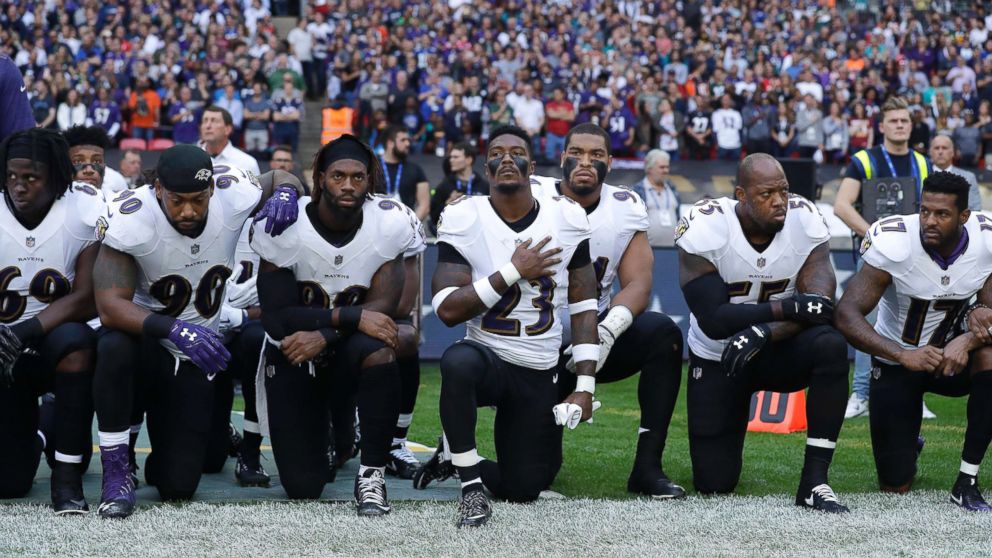
In Anthem Controversy, Kneelers are the Real Patriots

The controversy surrounding the national anthem has been framed as one between showing respect for country, flag and military personnel on one side, and the rights guaranteed in the First Amendment on the other. But there is a much more profound issue at play here, one that can be illuminated by considering the words of Abraham Lincoln.

In his Gettysburg Address, dedicating the national cemetery there, Lincoln noted that it was right and proper that we honor the dead through such ceremony. But he went on to note that such ceremony was meaningless if the cause for which they died, died with them. He thus proclaimed the only way to truly honor those who fell at Gettysburg – and all who fall in defense of liberty – is to dedicate ourselves to their cause. That cause is to ensure that a nation conceived in liberty and dedicated to the proposition that all men are created equal, not perish from the earth.

We've heeded his call. In the 150-plus years since that plea was made, we have fought steadily, if unevenly, to fulfill that vow made at Gettysburg. For some, that fight meant taking a seat in a school once prohibited because of skin color. For others, it meant taking a seat at a “Whites Only” lunch counter. And at least once, it meant taking a seat at the front of the bus. Today, for some who believe we have stalled in pursuit of that dream, that fight means taking a knee.

And just as those who integrated our schools, lunch counters and city buses faced the wrath of a public that felt such brazen acts of disregard for societal norms were out of place and disrespectful, so it is with those who take a knee. Likewise, those calls to stand up and show respect are reminiscent of those calls to get up from the counter, go to the back of the bus and stick with one’s own kind. It should surprise no one that such demands only stiffen the resolve, especially when they come from the highest office in the land. Where one would hope to find support in the fight for justice and equality, one finds only opposition and disdain.

When asked what kind of government the framers of the Constitution had devised, Benjamin Franklin famously replied, “A republic – if you can keep it.” One virtue of a republic, compared to direct democracy, is that it provides for majority rule while guaranteeing minority rights. We can debate how deep the racial attitudes underlying today’s concerns regarding those minority rights truly run, but we should not – cannot – deny that those concerns rightfully exist. This nation fought a deadly civil war to begin delivering those rights to an entire race. But as Lincoln noted, bowing our heads in reverence to those who died in battles past, or standing to honor the flag under which they fought, dishonors their sacrifice if we do so at the expense of fighting for their cause today. By that measure, those taking a knee are paying those who’ve fallen the highest honor.

TakeTheKnee trending hashtag reveals sharp debate over NFL players ...
Floyd Protests Revive NFL Kneeling Controversy (AP photo)

8/18/2017

Guns, The Constitution and Tyranny of the Strong

Comments by Virginia Gov. Terry McAuliffe, claiming that militia members “had better equipment than our State Police”—and that their weapons prevented law enforcement from imposing order and protecting peaceful protesters, go to the heart of why Second Amendment proponents arguing gun rights in the name of liberty miss the danger of their argument. 

It's been said countless times that total freedom leads to anarchy, and anarchy leads to tyranny of the strong. We saw that principle at work in Charlottesville last week, where there was no law, only anger and emotion, rendered unstoppable because many involved were invoking their Second Amendment right to keep and bear arms - and someone died because of the lawlessness that ensued. I fear we've not seen the last of such episodes. 

Sadly, too many view the lamentation of the Virginia governor as precisely how the Second Amendment is meant to work, as a protection against an overbearing government. That government forces were outmatched in armaments is viewed as a good thing. 

It is not. Our forefathers wisely stated that a well-regulated militia is necessary to secure a free state. They did not state that a well-armed, unruly mob is necessary to secure a free state. Every loosening of limits on guns increases the odds that events like that which took place in Charlottesville will become armed conflict. It may be those on the right who are most adamant about the Second Amendment guaranteeing unfettered access to firearms, but that right is not exclusive to them. It extends to all. We should not be surprised, therefore, when members of an undefined, anarchic group like Antifa exercises their Constitutionally protected right to arm themselves in anticipation of their next confrontation with the hate groups of Charlottesville. What transpires then will not be classified as terrorism, but civil war. 

God help us then.

The Pen is Mightier Than the Sword

I've long believed the First Amendment precedes the Second for a reason (beyond numeracy), namely that our founding fathers knew that the pen is mightier than the sword. More importantly, they understood that without principles of liberty in the First Amendment to defend, the guns protected in the Second Amendment defend nothing. 

Our current obsession with gun rights reminds me of the joke I've shared before about the construction worker who left work every day with a wheelbarrow filled with sawdust. Every day his foreman would search the sawdust for pilfered materials, but found nothing. After years of this, the worker arrived one day driving a new Mercedes. The foreman shouted, "I know you were stealing something! What was it?"

The worker replied, "A wheelbarrow a day." 

I often think the folks obsessed with the Second Amendment are unwittingly leading to a similar sleight of hand, wherein the First Amendment liberties we take for granted are being pilfered while we laser focus on protecting our right to keep and bear arms, A misguided focus, to be sure.

8/01/2017

Thank You, Senator McCain

 It’s rare that Senate votes carry the same tension as a March Madness game that goes down to the wire, but that is what happened when Senator John McCain courageously broke with his party to give a final thumbs down to the GOP’s attempt to repeal the Affordable Care Act (ACA), aka Obamacare. But unlike March Madness, where joy and disappointment are split between winners and losers, we should all breathe a sigh of relief that the attempt to repeal failed for several reasons.

The first is that this was not the Repeal and Replace that President Trump promised throughout his campaign. Instead, it was simply the first half of that promise - the easy half - which would have wreaked havoc on those who have come to depend upon the marketplace options offered through the ACA. Without a replacement, the market would have quickly reverted to the pre-ACA reality where those with pre-existing conditions would have been forced into high-risk pools, which carry far higher premiums that often price such folks out of the market. 

Furthermore, elimination of the individual mandate would have induced many healthy folks to forego insurance altogether. Without their premiums, the rates for those remaining were sure to rise. That is because premiums are priced based upon the total amount anticipated to be needed to pay expected claims. If healthy people drop out, there is obviously less revenue from premiums to pay claims, but since it is healthy people most likely to drop out, the cost of paying the claims of those remaining remains nearly, though not entirely, the same, leading to a shortfall that must be made up by charging higher premiums for those remaining.

This leads to what is known as the premium death spiral, where higher premiums force people who can’t afford them out of the market, leaving even fewer premiums to cover the cost of those remaining, forcing premiums even higher. It becomes a vicious cycle that leaves only the sickest (one hopes, for their sake) or the most well-off who are willing and able to pay such premiums covered (note that employer group health plans operate outside this specific market dynamic, a discussion for another time).

As it is, the Congressional Budget Office projected that as many as 17 million Americans would lose or forego coverage in the first year of repeal alone, with that number nearly doubling to 32 million by 2026.

Now, an argument can be made that it is unfair that healthy people should be forced to subsidize the premiums of those with serious health issues, but in a sense, that is what insurance is all about - the pooling of risk, where all pay in to protect against the unexpected. And while one may be healthy today, there is no guarantee that will remain true tomorrow. An auto accident or unexpected illness may arise at any time. In fact, that very thing happened to an uninsured family member of ours, who was seriously injured in a car crash while in his twenties, requiring air care and more than a week in the ICU. He ended up paying less than 10% of his total charges, the balance of which were covered implicitly in the future healthcare costs the rest of us paid. The individual mandate exists to ensure there are no such free rides, which is what one is getting when they play this game of health insurance roulette.

It should be noted that even F.A. Hayek, the grandfather of free-market economics, wrote in support of government-organized health insurance in his ground-breaking work, The Road to Serfdom. Providing the type of coverage available via the ACA, which isn’t even government health insurance, is hardly anathema to our free market system, which still largely relies upon private health insurers.

If anyone is to blame for the failure of this measure, a strong argument can be made that it is Donald Trump, who consistently promised a better plan but never produced one, leaving us to debate whether his was really better or simply nonexistent (I lean towards the latter). It was the lack of that replacement that Senator McCain cited when explaining his vote. So, while many in the GOP are calling John McCain a traitor, those same folks may want to look up Pennsylvania Avenue, from the Capitol Building towards the White House, in seeking a culprit to blame. Meanwhile, the rest of us - and especially those who have come to rely on the ACA to protect themselves and their families - should say a little prayer of thanks that John McCain, suffering from a terminal illness himself, found both the courage and the empathy to act in the best interest of those who need it most.

5/14/2017

Party or Constitution - Time for GOP to Put Up or Shut Up

In his farewell address, George Washington warned that political parties, which did not exist when he first took office, were likely “to become potent engines, by which cunning, ambitious, and unprincipled men will be enabled to subvert the power of the people and to usurp for themselves the reins of government, destroying afterwards the very engines which have lifted them to unjust dominion."

That is where we are today if Republicans in Congress choose to dismiss Donald Trump’s firing of former FBI Director James Comey as simply the exercising of presidential prerogative. This is not a time for partisan circling of the wagons to protect one’s own. Instead, it is time for the party that professes to be the great protector of the Constitution to embrace the fundamental separation of powers that our founding fathers recognized as the single best tool to check any attempt to subvert democracy itself.

Consider how such subversion might transpire – an ambitious candidate with little respect for Constitutional limits on power, a recognized lack of moral principle and a win-at-any-cost reputation decides to pursue the presidency, naming a former agent for Russian politicians as campaign manager.  As the campaign unfolds, a series of security breaches and releases of stolen communications take place against his opponent. Every intelligence agency involved in studying possible meddling identify with virtual certainty that those breaches were perpetrated by Russia with the intent of harming the candidate’s opponent.

Once elected, it becomes known that members of the campaign and transition team not only communicated with Russia after the election, but possibly before and that some lied about those communications. The FBI becomes central to investigating possible attempts by Russia to influence the election, which rightfully requires investigating the questionable contacts between the candidate’s team and Russian officials. This investigation becomes even more urgent given the unusual praise the candidate showered upon Russian President Vladimir Putin during the campaign.

Given all that, how could a president thwart such an investigation? Well, he could start by firing the person heading the most independent investigation of the election. That is precisely what Donald Trump did – and admitted to in an interview with NBC’s Lester Holt – when he fired James Comey. Given the circumstances under investigation, this is nothing less than democracy at risk.

Now, it is entirely possible that Donald Trump and his campaign are completely innocent in this case. But that is not for the president to decide, and if he tries to claim it is and obstructs law enforcement’s  pursuit of the truth, then it is the duty of Congress to step in and state that this will not stand. It is their duty to ensure that a full, fair and thorough investigation takes place. Moreover, Congressional members of both parties need to state in no uncertain terms that they understand the gravity of the situation and that country takes precedence over party. That is patriotism – and the elegance of our Constitution – at work.

Whether guilty or innocent, if this president can fire the person investigating potential wrongdoing – potentially treasonous wrongdoing – then so can the next president. The precedent regarding how such challenges to our democracy are addressed is being set now. Will the precedent be one of principle, or one of partisanship? The reputation of the Republican party and the future of the republic itself will largely be determined by whether Republicans choose loyalty to the Constitution or to their party. Their choice will determine just how prescient our country’s first president may have been.